.svg)
Why Most Marketing Misses the Mark
Most marketing budgets aren't wasted on bad ideas. They're wasted on the wrong kind of attention.
We see it constantly in client conversations: a business doubles down on price call-outs, loads up its messaging with features, or chases the kind of campaign that tries to force a decision instead of earning one. None of that is wrong, exactly. It's just aimed at the wrong moment, and it usually sounds like everyone else in the category, which means it doesn't actually do anything.
Here's the part that's easy to miss. People aren't persuaded by how impressive your product sounds. They're persuaded by how well you understand them. That's a different skill than writing good copy, and it's the one most businesses skip straight past.
Take something as ordinary as a pen.
Most pen marketing lives at the surface: ink type, grip material, barrel finish. It's the easiest level to write and the easiest level to copy, because it's just a list of attributes. A step deeper, some brands talk about a functional problem instead, smudge-proof ink for left-handed writers, a grip designed for long writing sessions. Still useful, but the product is still the subject of the sentence.
The level that actually changes behavior is different. It's not about the pen at all. It's about the moment someone signs a contract they've waited months to close, and they want the pen in their hand to feel like it matches the occasion. Or the student who's bombed three exams in a row and just wants one thing in their bag that won't fail them too. Nobody in either of those moments is thinking about barrel material. They're thinking about whether this object is going to let them down at the worst possible time.
That's the level where preference gets built, not because the messaging got louder, but because it finally found the actual stakes.
This is the real gap between feature-driven marketing and human-centered marketing. Feature-driven marketing asks people to compare. Spec sheets, price points, side-by-side charts: useful research material, weak motivation. Human-centered marketing does something else. It helps someone recognize their own situation in what you're saying, and recognition moves faster than comparison ever will.

This is also where commodity pricing stops being the threat it looks like. When two products solve the same functional problem, price is often the only thing left to compete on. But once one of them is also the only one that understands what's actually at stake for the buyer, comparison starts to break down. The buyer isn't choosing the cheaper pen anymore. They're choosing the one that gets it.
Once you see it this way, the fix isn't to talk louder or stack on more proof points. It's to get specific about two things: what your customer is actually tired of, and what their life looks like on the other side of the problem. Most businesses can describe their product in exhaustive detail and describe their customer's frustration only in vague generalities. That's backwards. The frustration is the part that should be sharp. The product description can stay simple.
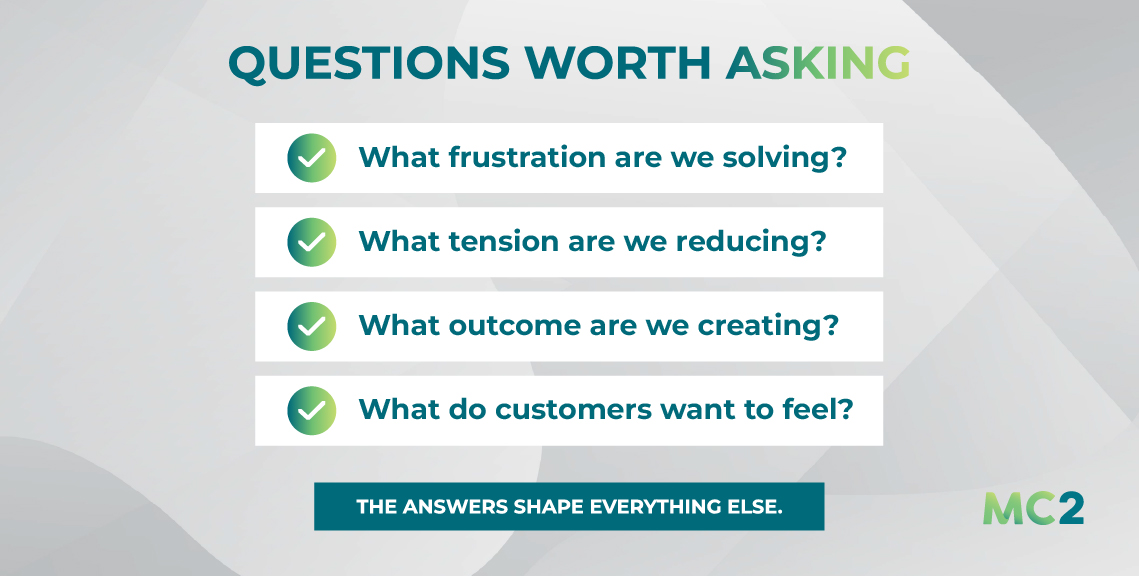
A useful test, if you want to know where your own messaging actually lives: pull up your homepage or your last five social posts and sort each line into one of three buckets. What describes the product. What describes the problem. What describes how the customer will feel once it's solved. Most businesses find that third bucket is nearly empty. That's not a copywriting gap. It's a clarity gap, and it's usually the first thing we work through with a client before a single campaign gets built.
If that's the gap you're noticing in your own marketing right now, that's exactly the conversation a FastTrack Blueprint session is built for. One day, one room, and a brand message your whole team can actually use the moment you walk out.