.svg)

How to Fix Your Marketing Problems Before It's Too Late
Most businesses don't realize they have a marketing problem until the consequences are already showing up.
Leads slow down. Sales feel harder than they should. Referrals dry up. The pipeline feels unpredictable.

At that point, marketing becomes reactive. People scramble for tactics—ads, social posts, new websites, new tools, new agencies, new ideas.
But the real issue is rarely tactics.
Marketing problems almost always start much earlier, quietly, and they compound over time. If you wait too long to address them, the fixes become more expensive, more stressful, and less effective.
Here's how to recognize the most common marketing problems, understand the real cost of ignoring them, and fix them before they become business-threatening.
Problem 1: You Don't Have Clarity, You Have Activity
Many businesses are busy marketing, but they aren't clear.
They post content. They run campaigns. They update their website. They send emails.
But if you ask simple questions, the answers are fuzzy:
- Who exactly are we trying to reach?
- What problem do we solve better than anyone else?
- Why should someone choose us over alternatives?
- What do we want people to do next?
Without clarity, marketing becomes noise. It feels productive, but it doesn't compound.
The Consequences
Your messaging sounds generic. Your audience doesn't immediately recognize themselves. Your team struggles to explain what you do consistently. Your sales process takes longer than it should. You rely heavily on referrals because cold or warm audiences don't convert.
Over time, this creates fatigue. Marketing feels like work with little return. Leadership starts questioning whether marketing even works.
How to Fix It
Clarity comes before creativity.
Start by answering a few foundational questions in plain language:
- Who is your primary audience—not everyone you could serve?
- What specific problem keeps them up at night?
- What transformation do you help them achieve?
- What makes your approach meaningfully different?
This isn't about clever words. It's about alignment. Once clarity exists, every piece of marketing becomes easier and more effective.
Problem 2: You're Chasing Tactics Instead of Building a System
A new platform launches. A new algorithm changes. A new tool promises faster results.
It's tempting to jump from tactic to tactic, hoping one of them will finally work.
The problem isn't experimentation. The problem is the absence of a system.
The Consequences
Without a system, results are inconsistent and unpredictable. You can't tell what's working and what isn't. Marketing feels dependent on constant effort instead of momentum. Budget decisions become guesses. Teams lose confidence in long-term strategy.
Eventually, marketing becomes exhausting instead of energizing.
How to Fix It
Think in terms of systems, not campaigns.
A healthy marketing system answers these questions:
- How do people discover us?
- How do they build trust with us?
- How do they move from interest to action?
- How do we stay visible over time?
This might include content, email, video, speaking, partnerships, or social media—but each piece plays a defined role. The goal is consistency and compounding, not constant reinvention.
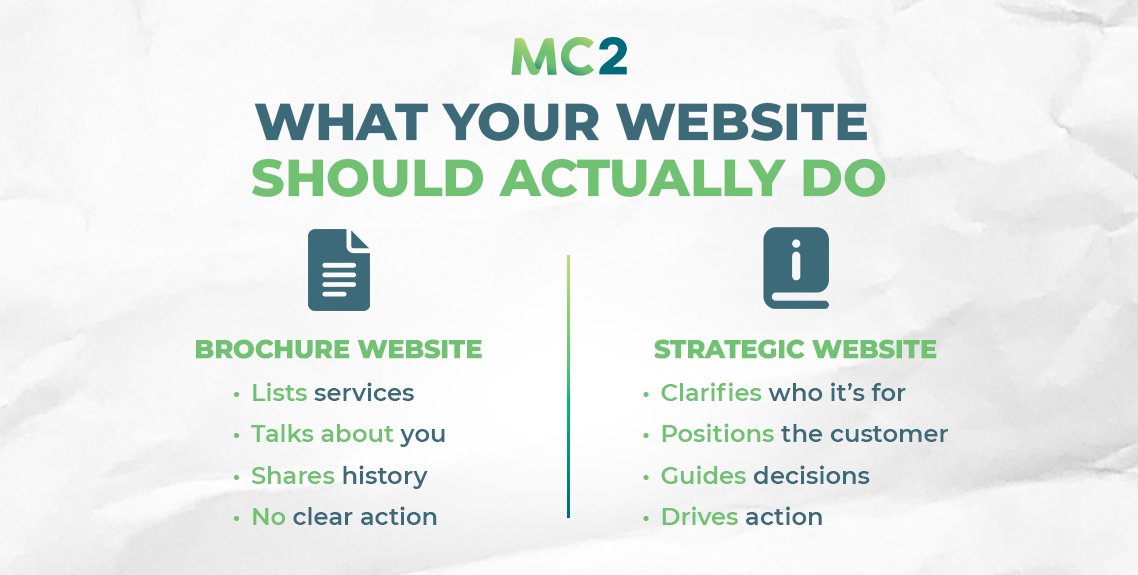
Problem 3: Your Website Is Informational, Not Strategic
Many websites look fine, but they don't work very hard.
They list services. They talk about the company. They explain history.
What they don't do is guide the visitor.
The Consequences
Visitors leave without taking action. Sales conversations start from zero instead of halfway. Marketing traffic doesn't convert. Your website becomes a digital brochure instead of a growth tool.
This is especially costly when every visitor matters.
How to Fix It
A strategic website does three things well:
- It clearly communicates who you help and how
- It positions your customer as the hero, not your company
- It gives visitors a clear next step
This doesn't require more content. It requires better structure, clearer messaging, and intentional calls to action.
Problem 4: You're Measuring the Wrong Things, or Nothing at All
If marketing success is defined as activity, it's hard to improve.
Posting regularly isn't a result. Launching campaigns isn't a result. Redesigning a website isn't a result.
The Consequences
Without meaningful measurement, decisions are driven by opinions, not insight. You repeat mistakes without realizing it. Marketing conversations become emotional instead of strategic. Leadership loses confidence in marketing investment.
Over time, this creates friction between marketing, sales, and leadership.
How to Fix It
You don't need dozens of metrics. You need the right ones.
Focus on:
- Lead quality, not just volume
- Conversion rates at key points
- Consistency of pipeline over time
- Cost relative to outcomes, not just spend
Measurement should bring clarity, not complexity.
Problem 5: You Wait Too Long to Fix What You Already Know Is Broken

This is the most dangerous problem.
Deep down, most leaders already know where marketing is weak. The website feels outdated. The messaging feels unclear. The strategy feels scattered.
But it keeps getting postponed because things are still working enough.
The Consequences
When you wait too long, fixes become urgent instead of strategic. Decisions are rushed. Costs increase. Opportunities are missed. Stress rises across the organization.
Marketing problems rarely announce themselves loudly at first. They whisper, then compound.
How to Fix It
The best time to fix marketing problems is before you're forced to.
That means stepping back periodically to ask:
- Is our marketing still aligned with who we are and where we're going?
- Are we building momentum, or just maintaining activity?
- Are we clear, or just familiar?
Small, proactive adjustments now prevent major overhauls later.
The Bigger Picture
Marketing problems are rarely just marketing problems.
They affect sales confidence. They affect team morale. They affect growth decisions. They affect leadership clarity.
The businesses that win long-term aren't the ones that chase every new tactic. They're the ones that commit to clarity, build systems, and address issues early—before the pressure is on.
Fixing your marketing before it's too late isn't about doing more.
It's about doing the right things, clearly, consistently, and intentionally.