.svg)
Knowing What Your Customers Want Is Only the Starting Point
Understanding your customer is critical. But it's not enough.

Many organizations do solid research, uncover meaningful insights, and still struggle to grow. The reason is simple: insight without positioning doesn't create advantage.
The next challenge is recognizing where opportunity actually lives in your market—especially the opportunities others are overlooking.
Growth doesn't come from doing what competitors already do, just slightly better. It comes from seeing the market differently and having the discipline to act on that perspective.
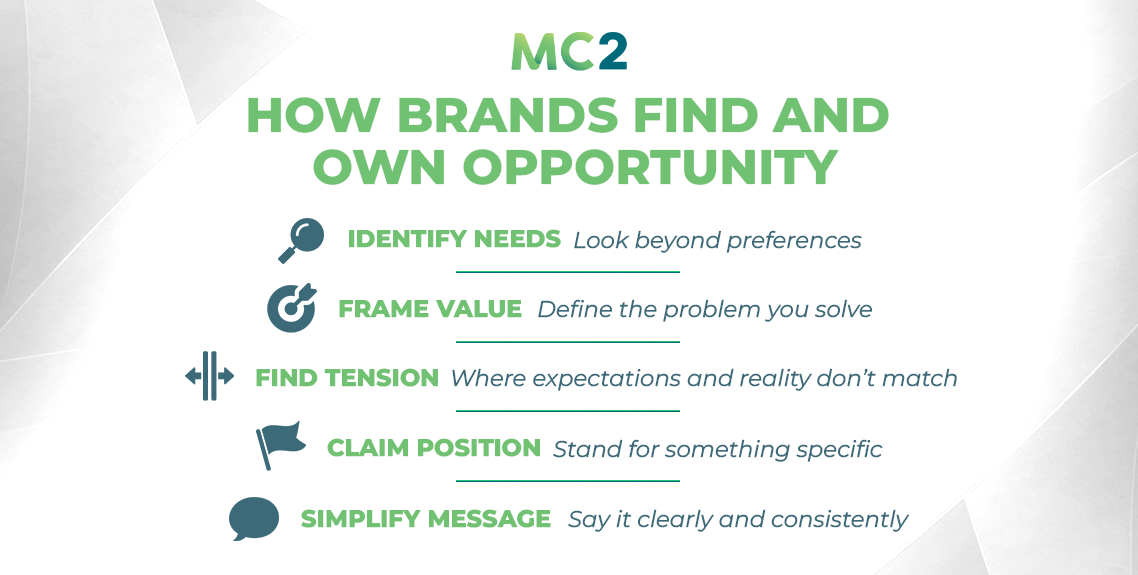
Step 1: Identify Core Customer Needs, Not Just Preferences
Customer research often produces a flood of information, much of it conflicting. That's not a failure of research. It's a reality of human behavior.
People struggle to articulate what they truly want. They can describe likes and dislikes, but not always the deeper drivers behind them.
The real work is listening for patterns:
- What frustrates them?
- What worries them?
- What do they avoid?
- What do they aspire to?
Those signals point to values. Values reveal needs.
Needs are far more powerful than opinions because they shape long-term decisions. When a brand aligns itself with a genuine need, it stops chasing attention and starts earning relevance.
Step 2: Frame Your Value Around the Problem You Solve
Most businesses try to differentiate by describing what they do. Their services. Their features. Their credentials.
Unfortunately, this rarely resonates.
Customers don't evaluate brands by how impressive they sound. They evaluate them by how clearly they solve a problem that matters.
A strong value proposition answers one question: What tension does this remove, or what outcome does this make possible?
The product is simply the vehicle. The value is the destination.
Until that distinction is clear, marketing tends to blend in.
Step 3: Look for Tension—That's Where Opportunity Lives
Every market has a gap between what customers want and what they're currently experiencing.
That gap creates tension.
It might be frustration, confusion, mistrust, inefficiency, or fatigue. Often, customers feel it but can't articulate it clearly.
This is where opportunity lives.
By studying competitor messaging, customer complaints, and unspoken dissatisfaction, brands can identify patterns others overlook.
When you address tension directly, your message feels relevant immediately. Not louder. Not flashier. Just more accurate.

Step 4: Claim a Strategic Position You Can Own
Being better is no longer enough. Being different without purpose is risky.
Strong brands stand for something specific. They make a promise the market can recognize and remember.
That promise becomes a mental shortcut. When people think about a certain outcome or value, they think of that brand.
Examples of this kind of positioning are well known:
- Volvo and safety
- Apple and individual creativity
- Nike and progress through effort
- Patagonia and environmental responsibility
These positions weren't chosen randomly. They emerged from understanding customer values and committing to a single, focused idea over time.
Strategic territory lives in the customer's mind. Owning it requires clarity and consistency, not constant reinvention.
Step 5: Distill the Idea Into Language That Sticks
Once the strategy is clear, it must be expressed simply.
A strong tagline or positioning statement isn't clever wordplay. It's disciplined clarity.
It captures the brand promise in a way that's easy to remember and hard to confuse.
This matters because attention is limited. If your message doesn't resonate quickly, it disappears.
The goal isn't perfection. The goal is commitment. Momentum is built through repetition over time, not constant refinement.
What This Means for Leaders
Many organizations struggle because they skip steps. They rush to tactics. They add more content. They chase more channels.
But clarity can't be skipped.
When you understand what your audience truly values, identify the tension they live with, and commit to a focused position, everything else becomes easier.
Marketing aligns. Sales simplifies. Decisions become more confident.
At MC2, we believe lasting brands are built by leaders willing to do this deeper work. Not louder marketing, but clearer thinking.
That's how brands earn trust. That's how they scale with intention. And that's how they last.