
If Your Strategic Plan Needs a Binder, Nobody's Using It
Every year around this time, a lot of leadership teams sit down to plan. Someone books a conference room, someone else pulls up last year's deck, and by the end of the day there's a document. Sometimes it's forty pages. Sometimes it's a spreadsheet with a tab for every department.
Then it goes in a folder. By March, most of the people who helped write it couldn't tell you what's in it.
We've facilitated strategic planning for businesses, chambers of commerce, and tourism organizations, and the pattern is remarkably consistent. The plans that get used are short enough to see all at once. The rest get filed.
How plans turn into planning theater
Most planning sessions start in the wrong place. The conversation goes straight to what the organization should do next year: a new website, more social media, an event, a hire. Tactics are easy to talk about. They're concrete, and discussing them feels like progress.
But when tactics come first, the strategy gets written backward to justify them. Nobody stops to agree on what the organization is trying to become, who it serves, or what problem it solves for them. Everyone assumes that part is settled. Usually it isn't.
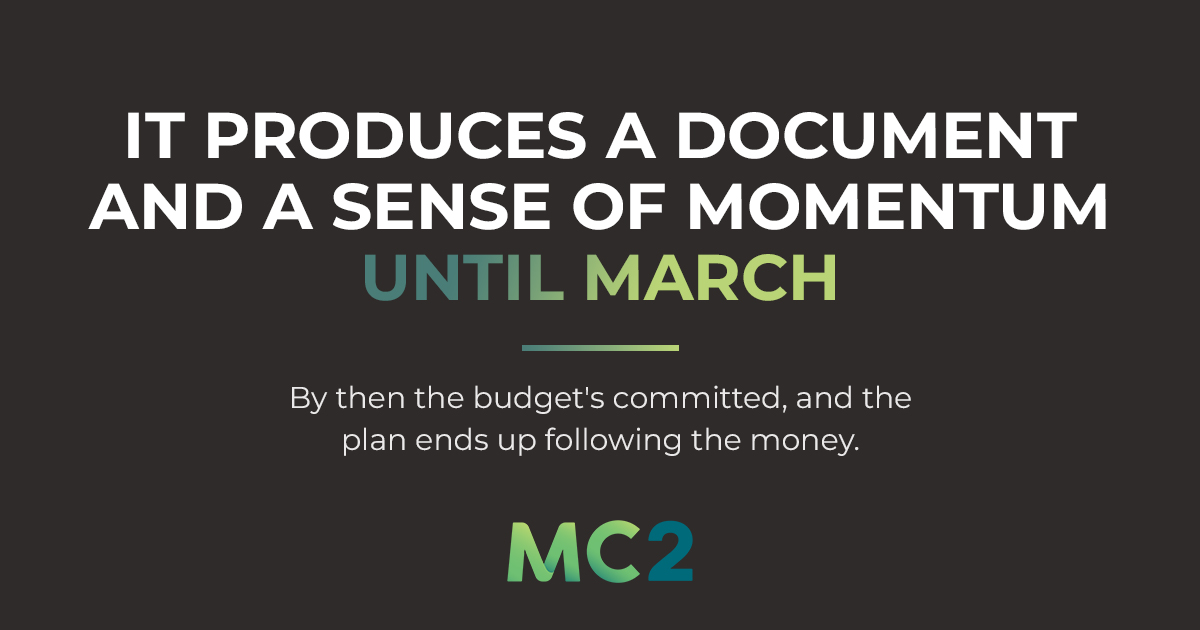
That's planning theater. It produces a document and a sense of momentum, and it holds up until about March, when the activity is happening and nothing's moving. By then the budget's committed, and the plan ends up following the money.
The plan that fits on a placemat
The strategic plans we build with clients end up on a single page. We call it a placemat, partly because it's about that size and partly because the good ones end up on the conference table instead of in a drawer.
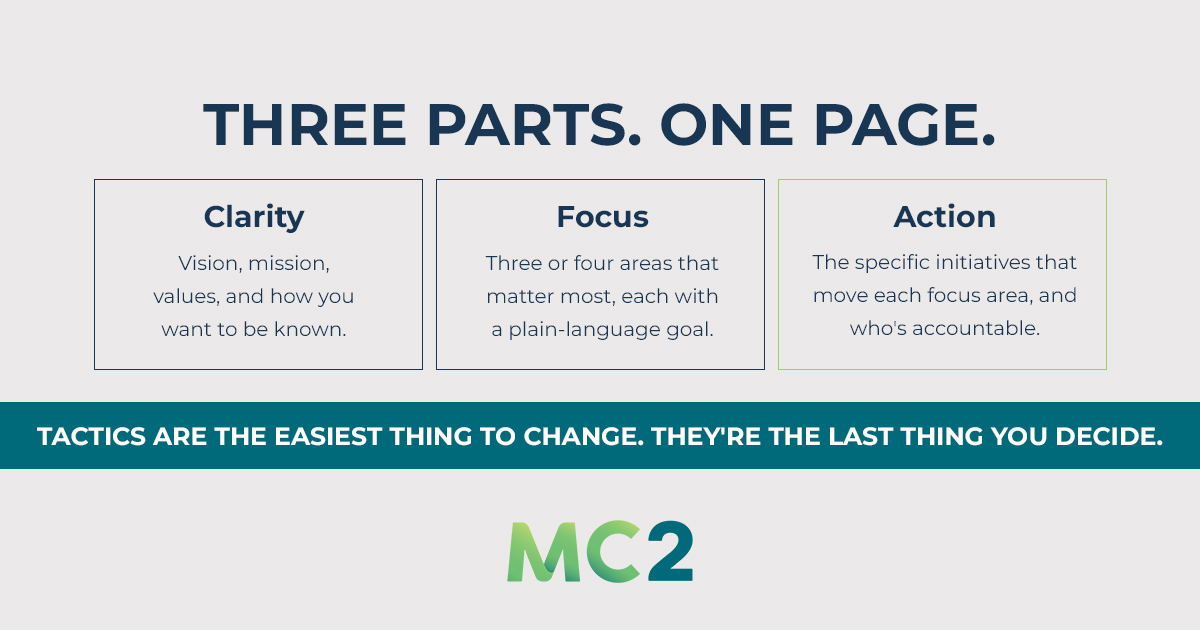
It has three parts.
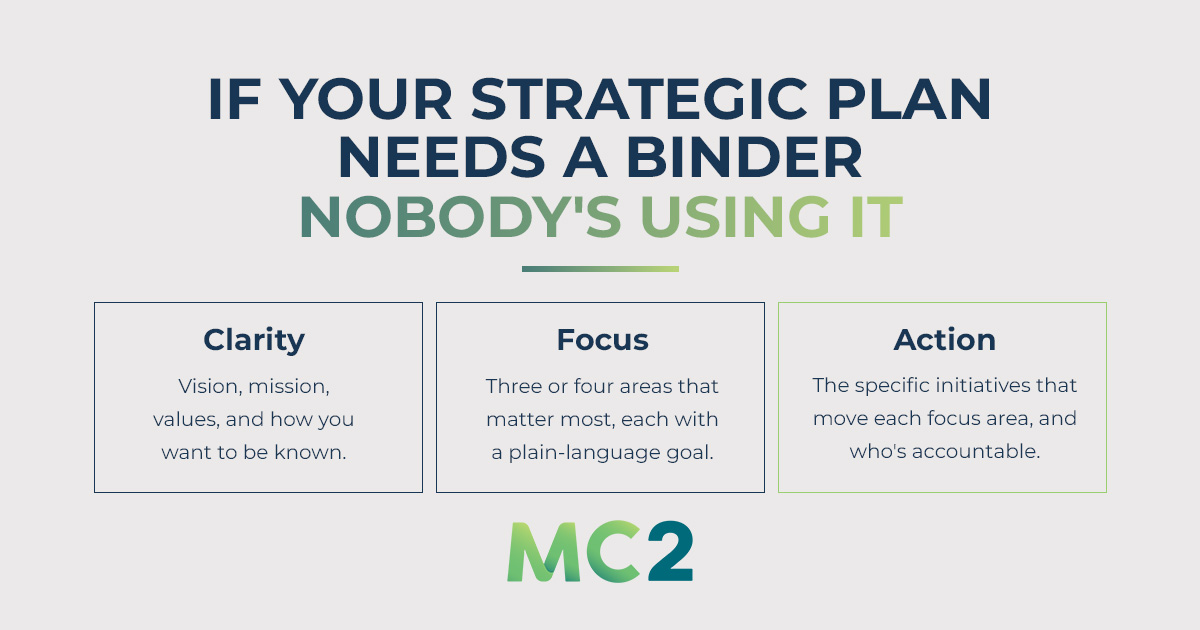
Clarity runs across the top: vision, mission, core values, how you want to be known, and a positioning statement. Teams usually want to skip this because they assume it's settled. Getting a board or leadership team to agree on it in plain language is often the most valuable hour of the whole process.
Focus sits underneath. Three or four areas that matter most over the next few years, each with a goal plain enough that anyone on staff could repeat it, and a handful of objectives under each. Three or four is deliberate. Every area you add past that quietly weakens the others.
Action sits beside it. These are the specific initiatives that move each focus area, along with who's accountable for them. This is where tactics finally belong. They're the easiest thing to change, so they're the last thing you decide.
Most of our placemats also carry a short list of key indicators, so you know whether it's working. Without that, teams end up grading themselves on effort.
What it looks like in practice
Explore Butte County came to us with work that was already succeeding. They didn't need to start over, and a good planning process shouldn't pretend otherwise.
We started with stakeholder surveys, so the people closest to the work had a voice before anyone sat down in a room. Then a half-day workshop to work through clarity, focus, and action together. They kept the initiatives that were working, layered in new objectives, and left with direction their staff could act on.

"MC2 led our strategic planning, and the process set the framework for our next three years." Nichole Farley, Explore Butte County
The framework matters. So does the fact that it fits on one page their team actually uses.
One thing to try before your 2027 plan
Before anyone suggests a single tactic this year, ask each person on your leadership team to write one sentence, on their own: what has to be true about this organization three years from now? Then compare them.
If the sentences line up, you're ready to plan. If they don't, you've found the most important item on your agenda.
When it helps to have someone in the room
Clarity is the hardest part to do from the inside. It's tough to lead a conversation you're also trying to take part in.
That's what our FastTrack Blueprint is built for: a focused working session to get clear on who you're for, what you're saying, and where your energy and budget should go next. If your plan for next year is still a list, let's talk.
