.svg)
If Your Ads Turn Off, Does Your Business Die?
Why businesses built on rented attention are fragile, and what it takes to build demand you actually own.
At MC2, we work with a lot of leaders who feel a quiet tension in their marketing. On the surface, things look fine. Ads are running. Leads are coming in. Dashboards are active. There is movement.
But underneath that activity is an uncomfortable question most people avoid asking out loud:
If the ads stopped tomorrow, would anything still work?
Not slower growth. Not reduced scale. We mean stop.
Would the phone ring?
Would anyone notice you disappeared from their feed?
Would customers still know where to find you, or why you mattered?
That question is not meant to shame anyone. Paid media has its place. We use it. Our clients use it. Ads can absolutely help accelerate demand.
The danger shows up when acceleration becomes the engine.
The addiction nobody talks about
Paid advertising is seductive because it feels controllable. You spend money, you get attention. You tweak creative, adjust targeting, refresh copy, and watch the numbers move. There is a dopamine hit that comes with watching cost per click drop or ROAS tick up.
But over time, something subtle happens.
Instead of asking, “Are we building something meaningful?”
You start asking, “How do we keep this from breaking?”
The business becomes dependent on rented attention. Algorithms. Platforms. Rules you do not control and policies that can change overnight. When performance dips, the instinct is almost always the same: spend more, test more, chase the next click.
That is not marketing strategy. That is survival mode.
If your business only works when ads are on, you do not have a brand. You have a dependency.
What 35 years has taught us
Over our 35 years working alongside businesses of every size, one pattern has been remarkably consistent.
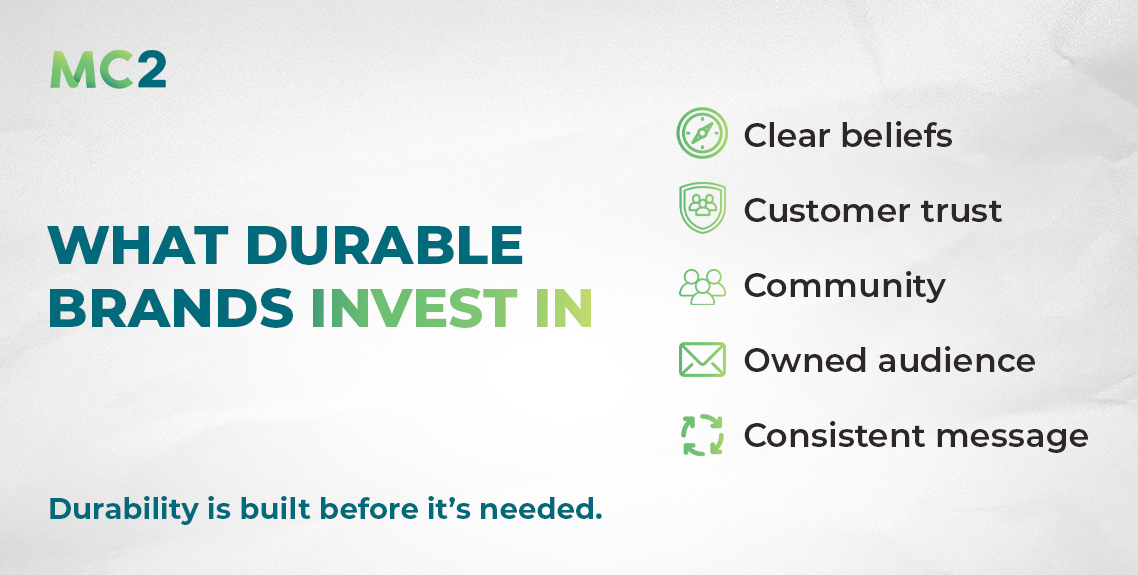
The companies that last are not the ones that mastered the latest platform first. They are the ones that invested early in clarity. They took the time to define what they stood for, how they spoke, and why their work mattered to real people. They treated brand strategy as the foundation, not the finishing touch.
Long before dashboards and attribution models, these businesses focused on authentic, human connections. They knew customers by name. They communicated with intention. They earned trust through consistency, not volume.
When new channels came and went, they adapted without panic. When platforms changed the rules, their business did not disappear. Their message still landed because it was never dependent on one tactic to survive.
That kind of durability does not come from chasing attention. It comes from building meaning.
Rented attention versus owned demand
Rented attention is anything you have to keep paying for just to be seen. Social ads. Search ads. Boosted posts. Sponsorships that disappear the moment the check clears.
Owned demand is different.
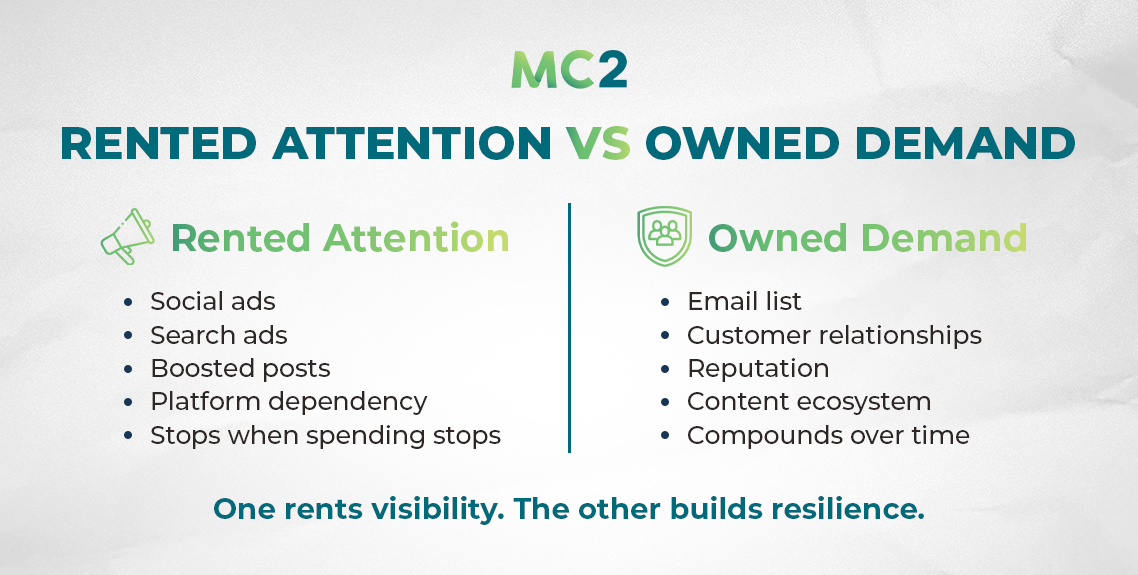
Owned demand lives in places you control.
Your email list.
Your customer relationships.
Your reputation.
Your content.
Your community.
When you own demand, people seek you out. They recognize your name. They understand your point of view. They trust you before you sell them anything.
This is the difference between interruption and invitation.
Paid ads interrupt. Owned demand invites.
One can work quickly. The other compounds.
Why funnels are not enough anymore
A lot of modern marketing advice still revolves around funnels. Capture attention. Push urgency. Optimize conversion. Move people through steps.
Funnels are not inherently bad. But funnels without belief leak.
People are tired of being processed. They are skeptical. They scroll past tactics they recognize. They opt out the moment the value feels transactional.
What people actually rally around are beliefs.
They rally around brands that stand for something clear. Brands that articulate a problem in a way that makes people feel seen. Brands that sound human, not optimized.
Movements create gravity. Funnels just create friction.
When your marketing leads with what you believe and why it matters, sales become a natural byproduct instead of the primary message.
Community is the missing link
One of the biggest misconceptions we see is confusing attention with connection.
You can have views without loyalty.
You can have followers without trust.
You can have reach without revenue.
This is why so many creators and influencers struggle to turn attention into a business. Content alone does not convert. Community does.
Community is what bridges the gap between content and commerce. It creates continuity. It gives people a place to stay instead of a reason to leave.
Here is a simple gut check we often ask clients:
If your audience disappeared from social platforms tomorrow, could you still reach them directly?
If the answer is no, you do not own the relationship yet.
Email lists, membership groups, customer ecosystems, and even consistent long-form content are not glamorous. But they are durable. They outlast algorithms.
Test the idea before you build the machine
Another trap of ad-dependent businesses is building before validating.
Paid ads can mask weak ideas. You can force attention long enough to believe something works, until the spend stops and the demand evaporates.
The healthiest brands we see do the opposite.
They test ideas before products.
Messages before campaigns.
Beliefs before funnels.
They put concepts into the world. They watch what resonates. They listen to responses, not just clicks. They measure interest, not vanity metrics.
This is slower at first. But it saves enormous time, money, and frustration later.
Where ads actually belong
To be clear, this is not an anti-ads argument.
Ads are a tool. A lever. An accelerant.
But they should amplify clarity, not compensate for its absence.
When you have a clear message, a trusted brand, and an audience that already cares, ads work better, cost less, and feel less desperate. They support momentum instead of trying to manufacture it.
The question is not whether you should run ads.
The question is whether your business can breathe without them.
A better question to ask
Instead of asking, “How do we get more leads this month?” try asking:
What demand are we building that we actually own?
What beliefs are we consistently reinforcing?
What relationships would survive if the platforms disappeared?
Those answers do not show up in dashboards right away. But they show up in resilience, trust, referrals, and long-term growth.
At MC2, we believe marketing should be clear, strategic, and human. That means helping businesses build something that lasts, not something that collapses the moment the ads turn off.
Because the goal is not to win the next click.
The goal is to build a business that still stands when the noise stops.
If you want to think through what that looks like for your business specifically — that's exactly the kind of conversation the FastTrack Blueprint is built for. Book a discovery call today!